
Invasion Day? The Myth of a Peaceful Australia Before Europeans
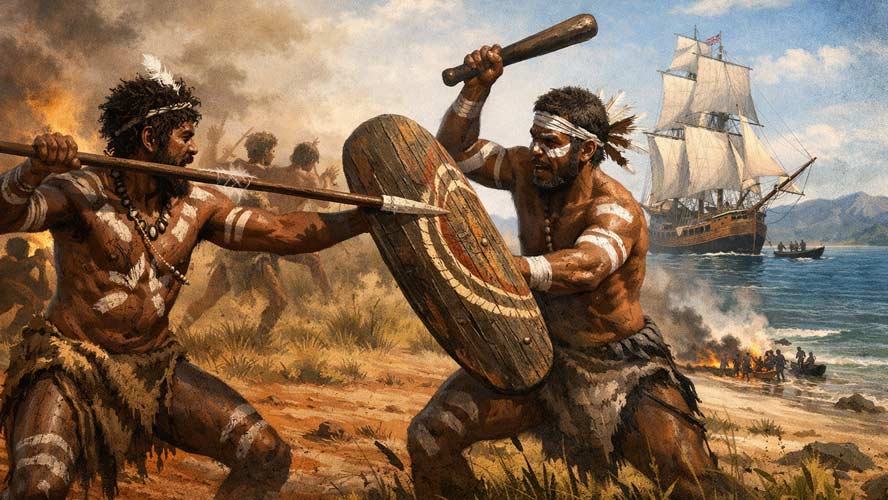
Every January, the word invasion is rolled out as if Australian history started on 26 January 1788. The claim is simple and emotionally loaded – Europeans invaded Australia, therefore all earlier history was peaceful and morally pure.
That idea collapses the moment you step away from slogans and look at how humans actually behave.
European settlement of Australia was real, overwhelming, and often brutal. No serious person disputes that. But portraying it as the only invasion in Australian history requires pretending that Aboriginal Australians were somehow exempt from the same forces that have shaped every other human society on Earth.
They were not.
Australia before Europeans was not a single nation living in harmony. It was hundreds of independent nations with borders, laws, alliances, rivalries, and conflicts. Those borders did not remain fixed for 65,000 years. They moved, shifted, and were fought over – just as they were everywhere else humans lived.
Territory does not remain static without force
Land ownership without enforcement is fantasy. Wherever humans settle densely enough to value land, conflict follows. This applies to Europe, Asia, Africa, the Americas, and yes, Australia.
Archaeology, linguistics, and anthropology all show that Aboriginal Australia experienced population movements, territorial expansion, and displacement long before Europeans arrived.
Language groups spread across vast areas over time. That does not happen by committee meetings. It happens because people move in, establish dominance, absorb smaller groups, or push others out.
Where one language replaces another, people have been replaced as well – either through force, pressure, or slow displacement.
This is not speculation. It is how historians reconstruct pre-literate societies.
Conflict was a feature, not an anomaly
Early anthropological records – written down before modern politics rewrote the narrative – describe warfare, raids, revenge killings, and territorial battles across the continent.
In northern Australia, seasonal warfare was common. Raids were carried out in dry seasons when movement was easiest. Victorious groups gained access to hunting grounds, water, or strategic routes. Losing groups retreated, merged with others, or vanished entirely.
Along major river systems, where resources were richest and populations densest, conflict was more frequent and more organised. You do not control a river system by asking politely.
Even in regions often romanticised as untouched, borders were defined, defended, and contested. Crossing into another group’s country without permission could be fatal. That alone tells you territory mattered – and was enforced.
Tasmania proves the opposite of what activists claim
Tasmania did not become isolated because Aboriginal people were driven there by other tribes. It was isolated when sea levels rose roughly 12,000 years ago. Before that, it was part of the mainland, and people moved across it as they moved elsewhere.
What isolation did was freeze populations in place. It did not create them, and it did not erase the conflicts that existed before the land bridge disappeared.
The later tragedy of Tasmanian Aboriginal history occurred after European arrival. That tragedy does not somehow erase the thousands of years of human behaviour that came before it.
The difference in 1788 was scale, not intention
Here is the uncomfortable truth many activists avoid.
The difference between pre-European conflict and European colonisation was not morality. It was power.
Europeans arrived with ships, firearms, animals, disease, industrial logistics, and the backing of a global empire. That turned localised human conflict into something overwhelming and irreversible.
But the idea of taking land, holding it, expanding it, and pushing others aside was not imported in 1788. That idea is as old as humanity itself.
To argue otherwise is to portray Aboriginal Australians not as fully human, but as mythological beings who lived outside history.
That is not respect. It is infantilisation.
“Invasion” is a moral term, not a historical one
In historical analysis, “invasion” describes movement and control. In political activism, it describes guilt.
If invasion only counts when one side loses badly enough, then history becomes nothing more than a scoreboard of victims. That is not how serious history works.
Every continent on Earth was shaped by successive waves of people displacing other people. Australia is not unique. What is unique is how modern debate pretends it was exempt.
A more honest way to remember Australia Day
Acknowledging that invasion, displacement, and conflict existed before Europeans does not justify colonisation. It contextualises it.
It allows us to say two true things at once:
- European settlement caused massive harm, loss of life, and dispossession.
- Human beings have always fought over land, including in Australia.
Only one of those statements is allowed in modern activist discourse. The other is treated as heresy.
History deserves better than that.
If we reduce 65,000 years of human life to a single morally convenient story, we are not honouring Aboriginal people. We are erasing their agency, complexity, and full humanity.
Australia’s past is not simple. Pretending otherwise does not heal wounds – it deepens them by replacing truth with mythology.
And mythology, sooner or later, always collapses under the weight of facts.